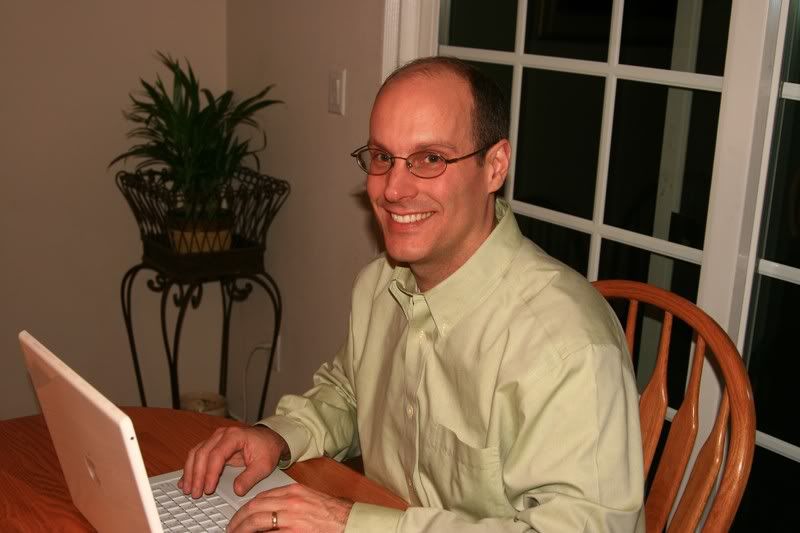
Writing legal thrillers is a natural fit with my “real job” as a Deputy Attorney General. Every day I come across fascinating cases and outrageous stories—though the best ones are too unrealistic to make good fiction.
Besides when you came to know the Lord, what is the happiest day in your life?
June 3, 1988—the day I married the love of my life, Anette.
How has being published changed your life?
In lots of ways, but mostly when my two worlds collide. Last week, for example, I was interviewing a very distinguished potential expert witness—a white-haired law professor with a thirty-page resume and six degrees. Then about an hour after I got off the phone with him, he sent me a fan e-mail telling me how much he and his wife like my books. Very flattering, but a little disorienting.
I can see how that could be. What are you reading right now?
High Crusade by Poul Anderson. It’s a fun old science fiction story that I read as a kid. It’s been out of print for years, but a 50th anniversary edition was just released.
What is your current work in progress?
The working title is Secret Murders and it’s a legal thriller. Here’s a sneak peak at the plot: In 1995, a death squad stole fourteen-year-old Christina Castillo from her family. Now attorney Marie Dupree must defend the man accused of masterminding this horrible crime. A victory could salvage her career and let her begin rebuilding a life shattered by her ex-husband’s betrayal. But before she can win, she must fight her way to the heart of a maze of dark and dangerous secrets—and does she really want to know the truth she’ll find there?
What would be your dream vacation?
If I could take a month and had unlimited funds (we’re dreaming here, right?), I’d love to visit Israel and walk the paths that Jesus walked and see the city that David built.
How do you choose your settings for each book?
I usually pick a place that I know well and will add to the story. For example, When the Devil Whistles is mostly set in and around San Francisco, and it was great fun to toss in real-life details about a favorite sea-front walk or how the rolling vineyard hills near my home look at sunset.
If you could spend an evening with one person who is currently alive, who would it be and why?
Denzel Washington. He’s a great actor, a committed Christian, and by all accounts a great guy. It would be an honor to meet him.
He's actually one of my favorite actors, too. What are your hobbies, besides writing and reading?
I really don’t have time for much beyond those, but I do go hiking or running with the kids when I can, and I’m a big college football fan (Go, Irish!).
My husband and I don't spend a lot of time watching sports, but now that the Texas Rangers are in the World Series, we're really supporting them. Josh Hamilton goes to our church, but we've never met him. (Big church.) What is your most difficult writing obstacle, and how do you overcome it?

What advice would you give to a beginning author?
There are three rules that worked for me and that I pass on to every new writer I meet:
1. Make writing part of your routine. Find a regular time when you can write and stick to it, even if it’s only one hour per week. It’s virtually impossible to write anything longer than a few pages or to grow as a writer unless writing becomes part of the rhythm of your life.
2. Learn to treasure good criticism. Find someone whose judgment you trust to critique your writing, and make him or her promise to be honest. Criticism is never fun to hear, but you won’t become a better writer without it.
3. Don’t give up. Most writers aren’t very good when they start. I was awful, and I still have the poetry to prove it. So keep writing and focus on getting better. You will.
Very good advice. Tell us about the featured book.
The title is When the Devil Whistles and it’s a legal thriller based on real cases that I handle at the Department of Justice. Here’s what award-winning author Colleen Coble had to say about it: “When the Devil Whistles has it all: high stakes, compelling characters and a fast plot that had me gasping at the twists and turns. A legal thriller you won't want to miss!” To learn more or read the first five chapters, go here: http://www.rickacker.com/books/when-the-devil-whistles/ .
Sounds very intriguing. Please give us the first page of the book.
Connor Norman loved a good fireworks show. He especially liked the ones that took place once or twice a year in the conference rooms at the California Department of Justice. Some executive or general counsel whose company was under investigation would come in for a witness interview, would lie, and would get caught. Then Deputy Attorney General Max Volusca would go off and the show would start. DAG Volusca did not suffer liars gladly. Fools he would tolerate, often longer than Connor. But if Max felt he was being misled, he soon lived up to his nickname, “Max Volume.”
Connor didn’t mind it when Max got loud. In fact, he liked the DAG’s outbursts because they usually rattled whoever was sitting across the table from him. And that usually meant more money for Connor and his qui tam clients. A qui tam plaintiff is a whistleblower who sues on behalf of the government and gets a cut (generally 15-20 percent) of whatever the government recovers. Better yet, if the Department of Justice likes a case, it takes on the lion’s share of the work. Envious defense counsel sometimes complained to Connor that he wasn’t really litigating these cases, just riding a gravy train driven by DOJ. Though Connor never told opposing lawyers, the real fun wasn’t the train ride so much as tying corporate criminals to the tracks in front of the engine.
Today, Connor’s client was Devil to Pay, Inc., a shell company he had created to bring qui tam lawsuits while protecting the identity of its owner. Most contractors assumed that Connor was the force behind Devil to Pay and that he recruited new whistleblowers for every lawsuit. In fact, all those suits were the work of a single woman: a professional whistleblower named Allie Whitman.
The corners of Connor’s mouth twitched. Allie was probably the most widely hated and feared woman in California’s government contracting industry, even though no one knew she existed.
Now I'm really hooked. How can readers find you on the Internet?
I’m on Facebook, Twitter (@authorrickacker), and my website is http://www.rickacker.com/ .
Rick, thanks for the interesting interview.
Readers, here's a link to the book. By using it when you order, you help support this blog.
Leave a comment for a chance to win a free copy of the book. New information: Please tell us where you live, at least the state or territory. I’m trying to get a good idea of where the people live who leave comments on my blog. (Comments containing links may be subject to removal by blog owner.)
Void where prohibited; the odds of winning depend on the number of entrants. Entering the giveaway is considered a confirmation of eligibility on behalf of the enterer in accord with these rules and any pertaining local/federal/international laws.
The only notification you’ll receive is the winner post on this blog. So be sure to check back a week from Saturday to see if you won. You will have 6 weeks from the posting of the winners to claim your book.
If you’re reading this on Feedblitz, Facebook, or Amazon, please come to the blog to leave your comment. Here’s a link.
http://lenanelsondooley.blogspot.com/